What Are Your Chances of Success on Appeal? Insights from Recent Cases
When someone is convicted or sentenced in a criminal court, they often ask a critical question: “What are my chances of success on appeal?” The criminal appeal process in Australia allows a convicted person to challenge errors of law, unfair procedures or manifestly excessive sentences. However, appeals are not retrials — success depends on well-defined legal grounds and the court’s view of whether a miscarriage of justice occurred. What Are Your Chances of Success on Appeal? Insights from Recent Cases
This article explains what determines the likelihood of success in criminal appeals, what Australian courts have said in recent decisions, and how to improve your prospects of a favourable outcome.

Understanding the Nature of a Criminal Appeal
Before looking at success rates and case insights, it’s important to understand what an appeal actually involves.
Appeals Are About Legal Error, Not Re-arguing the Facts
An appeal is not an opportunity to present the case again from scratch. Instead, it focuses on whether the trial judge made an **error of law or procedure**, or whether the verdict or sentence was **unreasonable or unjust**.
The appellant (the person appealing) must show that something went wrong that affected the fairness or outcome of the trial. Common examples include:
Incorrect direction to the jury
Improper admission or exclusion of evidence
Misapplication of sentencing principles
Ineffective representation by counsel
New or fresh evidence that could not have been presented earlier
Types of Criminal Appeals
In Australia, criminal appeals are generally of two types: 1. **Appeal against conviction** – challenging the finding of guilt. 2. **Appeal against sentence** – challenging the length or nature of the penalty imposed.
Appeals against conviction are generally harder to win because courts presume the trial was conducted correctly unless clear error is shown. Appeals against sentence have slightly higher success rates, especially where a sentence is manifestly excessive.
Statistical Overview: Success Rates in Criminal Appeals
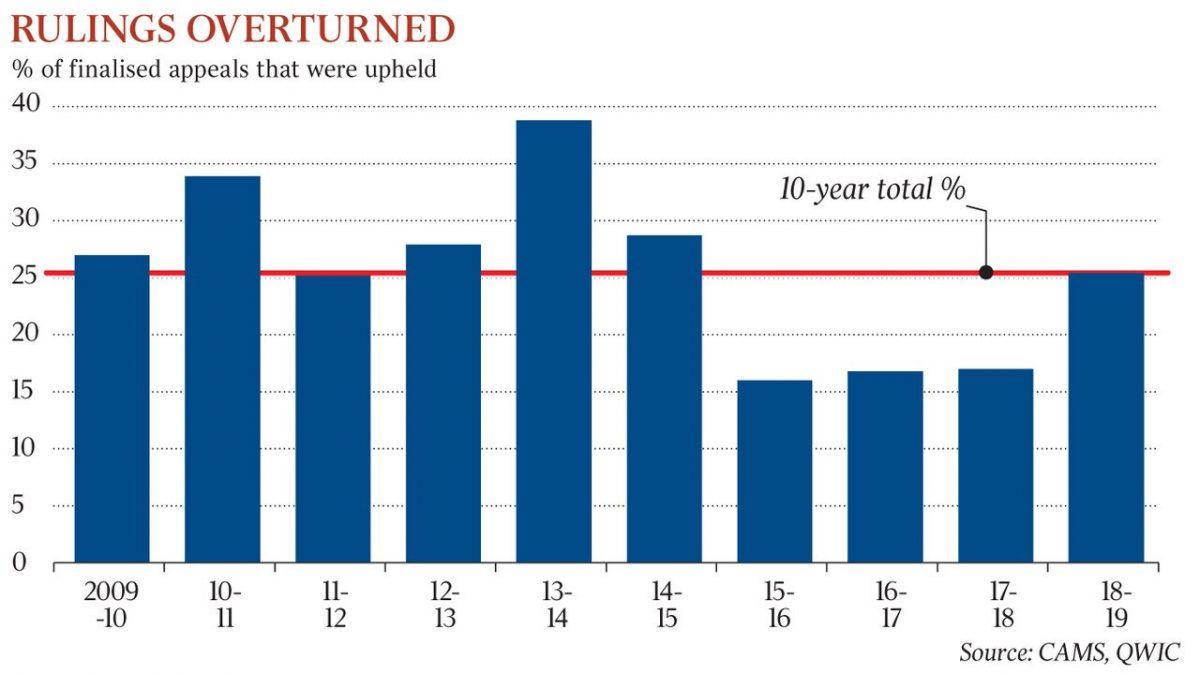
Although specific figures vary by jurisdiction and year, data from various Australian courts shows that only a minority of criminal appeals succeed.
Appeals Against Conviction
Historically, conviction appeals have success rates of roughly **10–20%** across Australian appellate courts. This means that around one in five appellants might obtain some form of relief, such as a new trial or an acquittal.
These appeals fail most often because appellate courts are reluctant to disturb a jury’s verdict unless the evidence is clearly unsatisfactory or the judge’s legal directions were plainly wrong.
Appeals Against Sentence
Sentence appeals fare somewhat better. Across most states, about **30–40%** of sentence appeals result in a reduction or variation of penalty. Courts are more willing to intervene where a sentence is “manifestly excessive” or where a principle of parity (equality between co-offenders) has been breached.
High Court Special Leave Applications
At the highest level, success rates drop dramatically. The High Court of Australia grants **special leave** to appeal in only a very small proportion of cases — often less than **10%** of applications. This shows how selective the appeal system becomes at higher levels.
Key Factors That Influence Your Chances of Success
Your prospects on appeal depend on multiple legal and practical factors.
1. Strength of the Grounds of Appeal
A well-drafted Notice of Appeal must set out clear, arguable grounds supported by law and evidence. Weak or vague complaints rarely succeed. Appeals based on “unreasonable verdicts” require demonstrating that no reasonable jury could have reached the same decision.
2. Availability of Fresh or New Evidence
Sometimes, new evidence emerges after trial — for example, DNA results, new witnesses, or retractions. Courts will admit this evidence only if it is credible, material, and could not reasonably have been obtained earlier. Successful appeals often rely on genuinely fresh evidence that undermines the original conviction.
3. The Quality of Legal Representation
Appeals require precise legal reasoning and familiarity with appellate procedure. Engaging experienced appellate counsel increases your chances significantly. Poorly prepared appeals, or those lodged without professional guidance, often fail due to procedural mistakes or weak argumentation.
4. Sentencing Principles and Precedent
In sentence appeals, success often hinges on how the trial judge applied sentencing principles such as proportionality, parity, and totality. A strong appeal demonstrates that the judge made a material error or imposed a penalty outside the accepted range for similar cases.
5. Standard of Appellate Review
Appeal courts show deference to the trial judge’s discretion. Unless a clear legal error is identified, or the outcome appears unreasonable, the appeal court will usually not intervene. Understanding this high threshold helps set realistic expectations for appellants.
Insights from Recent Australian Appeal Cases
Case 1: Misapplication of Sentencing Principles
In a recent state court decision, an appellant successfully reduced a lengthy prison sentence after the appeal court found that the trial judge gave excessive weight to deterrence and failed to properly consider rehabilitation prospects. The court held that sentencing must reflect both punishment and the offender’s potential for reform.
This case highlights that appeals can succeed when sentencing discretion is exercised on a wrong basis or results in an unjust outcome.
Case 2: Fresh Evidence Leading to Acquittal
Another notable case involved new forensic evidence that undermined the prosecution’s main theory. The Court of Appeal accepted the fresh DNA evidence, concluding that it created a reasonable doubt about the appellant’s guilt. The conviction was quashed, and a verdict of acquittal entered.
Such outcomes are rare but demonstrate that fresh, credible evidence can transform the result of an appeal.
Case 3: Unreasonable Verdict Appeals
In several recent appeals, defendants argued that the jury’s verdict was unreasonable. However, courts reaffirmed that overturning a jury verdict requires showing that the evidence, viewed as a whole, could not have supported the decision. Unless there is a glaring inconsistency or lack of proof, these appeals are unlikely to succeed.
Practical Tips to Improve Your Chances on Appeal
Act Quickly
Appeals have strict time limits, often 21 to 28 days from the date of conviction or sentencing. Delays require applying for an extension of time, which can weaken your position. Engage a lawyer immediately after conviction to protect your rights.
Focus on Strong Legal Grounds
Avoid scattergun appeals with too many weak arguments. Focus instead on one or two legally sound and well-supported grounds. Judges appreciate concise and focused advocacy.
Obtain a Detailed Transcript and Record
Your appeal depends on what happened in the original trial. Obtaining accurate transcripts and exhibits early allows your lawyer to identify procedural errors or evidentiary issues that could form the basis of appeal.
Engage an Experienced Criminal Appeal Lawyer
Appellate work is a specialised field. A lawyer familiar with recent case law, statutory requirements, and procedural rules can frame your argument effectively and present it persuasively.
Be Realistic and Prepare for Outcomes
Not every appeal succeeds, even with good arguments. Sometimes courts reduce sentences rather than overturning convictions entirely. Discuss likely outcomes with your lawyer and prepare accordingly.
Conclusion
So, what are your chances of success on appeal? Statistically, they are modest — but far from hopeless.
Conviction appeals succeed roughly 10–20% of the time.
Sentence appeals succeed about 30–40% of the time.
High Court appeals are rare and highly selective.
Your prospects improve when the appeal is based on clear legal error, credible fresh evidence, or misapplication of sentencing principles. Early preparation, experienced representation and strong, focused arguments are the cornerstones of a successful appeal.
For anyone considering an appeal, understanding both the challenges and opportunities in the appellate process is essential. With careful planning and sound legal advice, an appeal can provide a genuine second chance at justice. What Are Your Chances of Success on Appeal? Insights from Recent Cases